Nothing is easy.
I'm taking a class online at the moment, and guess what, kids? I'm using Blackboard as a student. It's as bad as I knew it would be.
As a teacher, I understand that it's hard to navigate the dashboard, post materials, and make everything work smoothly. Now, as a student, I see that even when an experienced teacher is doing a great job, Blackboard still is a crushing barrier to conveying content. The charts do not line up and the layout looks like a crumpled and scanned Wall Street Journal page. Nothing is intuitive and navigation is limited by having to go breadcrumb by breadcrumb to the destination.
Yes, nothing is easy, but some things make it even harder, like platforms that hit the mainstream and force us to suffer at their mercy.
During the 2012-13 school year, therefore, I resolve to find alternatives that will save my students from the pit of Blackboard! There will be more Google docs, there will be more Edmodo, there will be more Testmoz, there will be more Wordchamp!
And it will get easier. Because we'll make it easier!
From a Latin teacher at a middle school, here's the stuff that is causing thinking and change, anxiety and growth, angst and hope!
Showing posts with label wordchamp. Show all posts
Wednesday, July 25, 2012
Saturday, July 9, 2011
Brain Rules

Brain Rules by John Medina is my current obsession. With a simple set of rules and the neuroscience to back it up, he presents the best ways to learn, the complications that we face in learning and some solutions that make perfect sense given the direction that we need to head in education.
This point, about recognition of vocabulary, in particular attracts my attention as a Latin teacher. I've sung the attributes of Wordchamp, but Brain Rules shows not only why it works but how to make it even better-something that is a constant challenge. We know that when students practice new vocabulary with a picture they hold onto the knowledge longer-but how do we increase the power of the connection and make sure that no matter the context, the learning is maintained? Well, the research here says that one of the options we should be making more use of is showing the picture, and saying the word aloud WITHOUT the text below the picture. Not every time, but definitely at certain times in the learning process. Why? The visual interpretation of the writing of the word can create interference-we can get a stronger, more direct connection by using the picture/sound combo especially if it's got a good emotional trigger.
More cards like this:
So how should I apply this? I have s
tacks of hundreds of vocabulary "cards" in wordchamp, and I need to examine them to make sure the picture is on the right mark, and also make copies of the sets WITHOUT the text, and assign the students the task of viewing/listening (which is easily done in wordchamp). After they hit okay, the student hears a voice say the correct word.Next, attention and multitasking.
Thursday, May 13, 2010
Wordchamp Wednesday
Another great success (that originated in failure) occurred over the last 7 days. My 7th grade students had been making great strides with neuter nouns, even to the point of writing their own stories. Matthew Webb once shared a terrific story about monsters and rocks (monstra et saxa, which are neuter nouns) and last year my classes wrote the second war of monsters and rocks with their own graphics. This year we continued the tradition with a third war in which the students could incorporate more characters of their choice. The grammar was coming along beautifully and I thought all was well. Well it was not.
The evaluation asked the students to examine sentences from the stories that they had written themselves and identify subjects (nominatives) and direct objects (accusatives). We had an epic fail. 3 A's, 2 B's, 18 C's, 21 D's, 2 F's.

Not what I anticipated. So, re-teaching was necessary. I designed three wordchamp exercises that isolated the problems separately: English knowledge of subject/direct object, Latin recognition of nominative/accusative, Correlating the term nominative with subject and accusative with direct object. Students completed the exercises until they were scoring in the 90's (it took some 11-12 tries). They recorded on paper their starting scores and final scores in the exercises and reflected upon what they now understood better about the concept. Then, we re-read stories in small groups to practice the skill in context, and I retested (and held breath).

Results? You bet. New scores: 28 A's, 14 B's, 3 C's and 1 D. Targeted reteaching works. What had gone wrong? The idea of English subject and direct object was not clear for a portion of the students, and this combined with a lack of understanding of the Latin terminology for cases compounded the problem. Students were writing the Latin correctly, but didn't know WHY it was correct. Now they have the concept with the terminology and will be able to transfer it to new situations-that's what I wanted, it just took a side alley to get there.
What will I do differently next year? After I pre-test with an English sample that is similar to the 6th grade English curriculum on subject and direct object, I'll have a follow up assignment with an unfamiliar topic to make sure I'm getting consistent results about what they know (in English), not just what they memorized. Also, I'll have activitites prepared for the students who need reinforcement of the basics, and extension ready for the ones who have it mastered. Yes, they had the skill at one point, but it didn't stick and it didn't transfer, so that's what I'm now prepared for.
Thursday, April 29, 2010
Latin neuter nouns
Today the 7th grade students practiced their neuter noun patterns in wordchamp and became adept at using the pattern. One student called me over and said, "Hey, I found a pattern, it's always "a" when it's a plural subject." Yes, he'd heard me say it, watched me write it, wrote it himself, but it wasn't until he was getting a score from the computer that it CLICKED.
I also put a screencast on blackboard so that they could get an overview while studying tonight. Here's what they will see.
Wednesday, April 21, 2010
Wordchamp Wednesday
After discussing Wordchamp withesteemed colleagues (Kerry Daus and K.C. Kless)
I decided to establish Wordchamp Wednesdays.
Why? Because there are too many accolades
to pile into one post.
Over the past few months, I have kept referring to this article: http://www.encounters.jp/mike/professional/publications/vocabulary.html by Michael P. Critchley, and its profound statements have helped me quite a bit in fashioning formative exercises for my students.
Today, I will be addressing what he calls fine tuning the approximate meanings learned from a word list.
First, here is an example of a student's first try with a set of vocabulary. In it, you can see the student spent about 5 minutes on the words and got 17 right the first time. Wordchamp puts words that are missed back in the stack, and then the student has to get it right two more times in order for it to go into the "correct" category. So, this student missed 10 originally and then made the corrections.
Same student, next attempt. Look at the improvement.
Within Wordchamp, a teacher has access to a webreader which allows a student to hover over a word and see the meanings of that word in a dictionary-style entry. Because there are a variety of meanings provided, the student must use an approach that can elicit the best meaning for the word in context. When a student has memorized a single meaning from a vocabulary list s/he is at a disadvantage, because the flexibility in meaning is eliminated. A methodology which encourages negotiation of meaning helps the student to improve fluency.
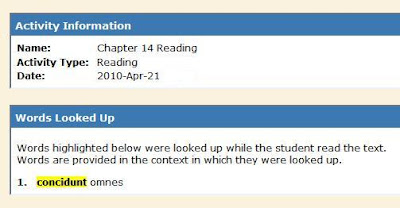
Here's a picture of info provided by Wordchamp about a student's reading experience. It's showing me what words the student is having to hover over as she reads along in context. The student can click on those words and practice them, then try the reading again. This student practiced her list and did the reading a second time.
1st try:
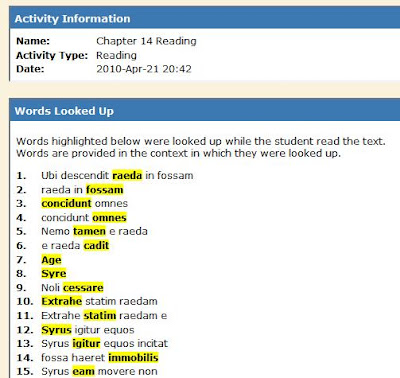
2nd try, after practicing the words. Notice, ONLY ONE WORD is a challenge this time.
Anecdotal evidence: Students (17) who spent 20-30 minutes and assembled their own list of associative meanings for words in an original reading scored in the 4-5 range of proficiency as opposed to students (22) who spent 5-15 mintutes and did NOT assemble a word list, and scored in the 1-3 range range of proficiency.
What we are seeing is that students who "hover" and choose a meaning that has context, then practice that meaning, have a better ability to negotiate meaning when they are in situations where the original "memorized" term does not apply.
Wordchamp provides a visual rendition of which words the student "hovered" over, and also a list of "most missed" words from a vocabulary list. The teacher can also assemble contextual sentences to teach various meanings of the same word-the skill that we implicitly employ in our native language.
Furthermore, when presented with the information, even 7th-8th grade students understand the implications. As I presented data about 5 or 6 vocabulary words, the students verbally made the connection and created conditions (individually) for their own re-learning of the words. I'm looking forward to seeing what these children do with the work in 8th, 9th, 10 and nth grades!
Monday, April 12, 2010
Formative Assessment

Getting students used to formative assessment is one thing, and explaining it to parents is another.
I love Graphjam and this one really sums up formative assessment. First you have to figure out what's going to flip the learning switch, then you can actually flip it. The problem is reducing the time fumbling around so that you go straight to the switch.
Bit by bit over the school year I've earned the students' trust so that they know when I say "I just need information about where you are" or "I need a snapshot" they understand that they should just do their best and expect a lot of feedback. Really, it took several weeks for them to get used to papers coming back with lots of ink (in green or purple) that told them what they were doing right, and what they needed to do to master the material. Then, it took a few weeks for them to get used to having follow-up activities based on what they needed (do THIS wordchamp exercise) When it was a matter of basics, they had a basic activity. If they had mastered the material, they had an extension that took them to the next level (but keep in mind, that all we needed was the basic, the extension was whipped cream on top). Then, I would analyze how they did on the specific assignment (how many times did it take them to master the pattern? how many minutes did it take? what kinds of errors are they making, spelling/careless, or substance/reversals?). Finally, when THEY felt they were ready, they could take a second assessment. This involved me saying, "I see you've done the work in wordchamp, and you are getting the answers right about 90% of the time, and we've talked about the problems. Do you feel ready to show your best work?" The answer was "yes" every time, and every time there was improvement.
Now, for the hard part. I recorded the first evaluation in gradebook with no weight, and an explanation as to how it was not a weighted grade, just an indication of our starting point. Also, in blackboard I had a note to parents referring to how I was tracking the students' growth, and that my goal was to get every student to proficiency on an objective, and that time line might be different for different students. Then, a second, weighted grade was put in AFTER the student had participated in the re-learning and mastery strategies.
As a teacher, this has been a challenging idea for me to wrap my brain around: that it's fair to give a student an A when they get it the first time, and it's fair to give another student an A when it takes them an extra few days, reteaching, practice, then mastery is shown. Now, I teach in middle school and I'm not sure that I would feel the same in a competitive high school situation, and from the feedback I've gotten from parents, I'm not sure that they will embrace it in a high school setting either. What are your experiences?
I'm seeing great things from the students. They have a "no one gets left out" attitude and everyone has had to participate in some reteaching and extension activities. In fact, they are starting to track their OWN progress (this was my devious plan all along), and have guessed that I'm going to have them create a record of their learning. The students will be pinpointing what types of activities helped them most, which are NOT always coinciding with their learning styles, by the way, and will eventually be choosing the type of activity that is right for them after a group introduction to a concept. Hmmm. Could I compact it? We'll see!
Saturday, April 10, 2010
Wordchamp

This is (I'm sure) my first praise entry about Wordchamp. We've been using it for three years now. It provides huge advantages. K.C. Kless, my compatriot introduced it after attending a conference. He must be credited with all the leaps that our students have made with this advantage! You create a class, students join and complete the assignments that you post and the best thing-the DATA. It shows you how many times a student practiced the item, the most missed items for the group (reteach these in class) , the easiest items (skim these in class). And read between the lines-it shows you what they said so that you can interpret what mistakes are happening and address them directly with the particular student!
The webreader that it provides allows you to give students passages for comprehension, and, get this-they create THEIR OWN practice list. Completely individualized education in which they practice the vocabulary and grammar that THEY are hovering over-not what someone else might need. Then, the teacher can look at what they did, recognize it, use it to shape new lessons and help them get to the end goal. The student takes control of his/her own learning and this is the best example that I can provide of a student-led culture of learning.
Subscribe to:
Posts (Atom)